Choosing the right baler can make a significant difference in how efficiently your business handles recyclable materials. The best machine for your operation will depend on several factors, including the type and volume of material you process, available floor space, labour requirements, desired bale size, and how finished bales will be stored or transported.
From compact vertical balers for lower-volume applications to high-capacity horizontal and two-ram systems for demanding recycling operations, there is no single baler that is right for every business.
Understanding the differences between baler types can help you narrow down your options and select equipment that supports your current needs while leaving room for future growth.
Why Choosing the Right Baler Matters
A properly matched baler can help streamline waste and recycling operations while making recyclable materials easier to manage.
The right equipment can help your business:
- Reduce the space required to store recyclable materials
- Improve material handling and recycling efficiency
- Reduce the amount of manual labour involved in waste management
- Produce consistent, manageable bales for transportation
- Reduce the frequency of waste and recycling pickups
- Improve housekeeping and organization around your facility
- Prepare your operation for increasing material volumes
Choosing a baler that is too small can create bottlenecks and unnecessary labour. At the same time, selecting equipment with significantly more capacity or automation than your operation requires may add unnecessary complexity and cost.
The goal is to find the baler that best matches how your facility actually operates.
What Material Will You Be Baling?
The first question to consider is what materials your business needs to process.
Balers are commonly used for materials including:
- Corrugated cardboard and OCC
- Paper
- Plastic film
- PET and HDPE plastics
- Aluminum cans
- Textiles
- Packaging materials
- Other recyclable commodities
Different materials behave differently when compressed. Lightweight plastic film, for example, presents different handling requirements than corrugated cardboard or rigid plastic containers.
Material type can influence several equipment considerations, including compression force, feed opening size, bale density, tying method, and the way material is loaded into the baler.
Businesses processing several different recyclable materials may also require greater flexibility than operations primarily baling one consistent material stream.
How Much Material Does Your Business Process?
Material volume is one of the most important factors when choosing between baler types.
Lower-Volume Operations
Businesses producing relatively small quantities of cardboard, plastic, or other recyclables may benefit from a vertical baler.
These machines have a compact footprint and are commonly used where space is limited and materials can be loaded manually throughout the day.
Moderate-Volume Operations
As recycling volumes increase, businesses may begin to benefit from larger balers that provide greater throughput, larger feed openings, or more efficient material handling.
Warehouses, distribution centres, manufacturing facilities, and larger retailers often fall into this category.
High-Volume Operations
Facilities processing substantial or continuous volumes of recyclable material may require horizontal balers, automated feeding systems, or other high-capacity equipment.
At this level, throughput and labour efficiency become increasingly important. Equipment that can process material continuously can help prevent recycling operations from becoming a bottleneck within the facility.
Vertical vs. Horizontal Balers
One of the biggest decisions when choosing a baler is whether a vertical or horizontal configuration is better suited to your operation.
| Factor | Vertical Balers | Horizontal Balers |
|---|---|---|
| Typical Material Volume | Lower to moderate | Moderate to very high |
| Footprint | Smaller | Larger |
| Feeding | Commonly manual | Manual or automated |
| Throughput | Lower | Higher |
| Labour Requirements | More operator involvement | Can be reduced through automation |
| Typical Applications | Retail, grocery, smaller warehouses and facilities | Warehousing, manufacturing, distribution and recycling operations |
| Best Suited For | Businesses needing a practical, space-conscious recycling solution | Operations processing larger or more continuous material volumes |
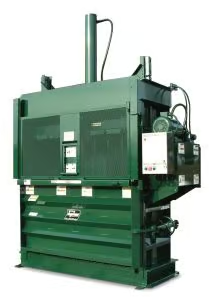
When Does a Vertical Baler Make Sense?
Vertical balers are often a good choice for businesses that generate recyclable material steadily but do not require continuous high-volume processing.
Their smaller footprint makes them particularly useful where floor space is limited.
They are commonly considered for:
- Retail stores
- Grocery operations
- Smaller warehouses
- Commercial facilities
- Businesses primarily processing cardboard and similar materials
When Does a Horizontal Baler Make Sense?
Horizontal balers are designed for operations requiring greater throughput and processing capacity.
They can be integrated with conveyors and other material handling systems, making them well suited to facilities where recyclable material is produced continuously or in large quantities.
Common applications include:
- Distribution centres
- Manufacturing plants
- Recycling facilities
- Large warehouses
- Packaging operations
- High-volume commercial facilities
Understanding the Different Types of Horizontal Balers
Not all horizontal balers operate in the same way. The right configuration depends on your material stream, throughput requirements, labour availability, and desired level of automation.
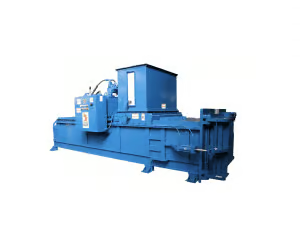
Closed-Door Balers
Closed-door horizontal balers produce dense bales while offering a relatively straightforward operating configuration.
They can be a strong choice for businesses that need greater capacity than a vertical baler but do not necessarily require a fully automated continuous baling system.
Closed-door balers may be suitable for warehouses, manufacturing operations, distribution facilities, and other businesses processing moderate to substantial quantities of recyclable material.
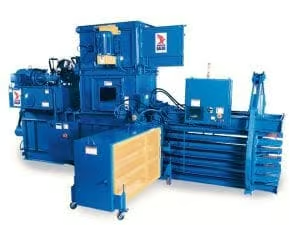
Auto-Tie Balers
Auto-tie balers are designed to automate the bale-tying process, helping businesses process greater volumes of material with less operator involvement.
They are particularly valuable in operations where throughput and labour efficiency are priorities.
Automated horizontal balers can often be incorporated into conveyor-fed material handling systems, allowing recyclable material to move through the baling process more efficiently.
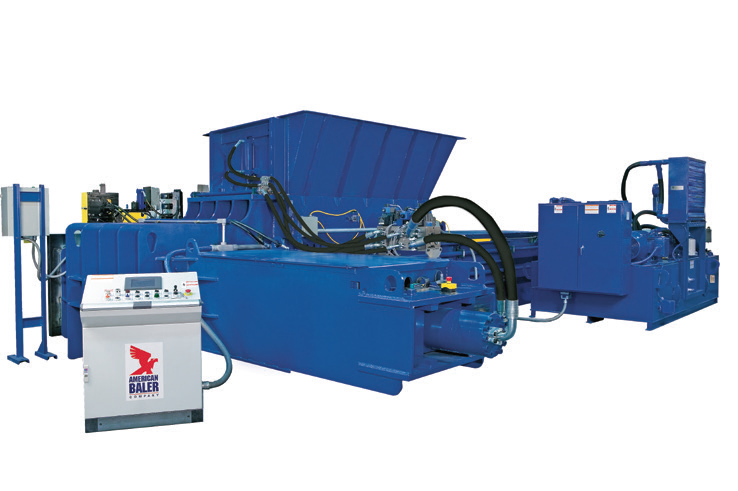
Two-Ram Balers
Two-ram balers provide a high level of flexibility for demanding recycling applications.
Unlike many traditional balers, two-ram systems are well suited to facilities processing multiple material types. This makes them particularly useful for recycling and waste management operations handling diverse recyclable commodities.
They are commonly considered when material flexibility, high throughput, and dense bale production are important operational requirements.
Questions to Ask Before Choosing a Baler
Before selecting equipment, take a closer look at how recyclable material moves through your facility.
Consider the following questions:
What materials will we bale?
Identify both your primary recyclable material and any secondary materials you may want to process.
How much material do we generate?
Consider daily, weekly, and seasonal volumes rather than looking only at an average.
Are our recycling volumes likely to increase?
Equipment should support your current operation without immediately becoming undersized as your business grows.
How much floor space is available?
The physical layout of your facility may influence whether a vertical, horizontal, or automated system is practical.
How will material be loaded?
Consider whether operators will manually load the machine or whether conveyors or other material handling equipment could be used.
How much operator involvement is practical?
Higher levels of automation may reduce the labour required to process larger volumes of recyclable material.
What bale size and weight do we need?
Your recycler, material handler, transportation process, or downstream equipment may influence preferred bale specifications.
How will finished bales be moved?
Consider forklift access, storage space, loading procedures, and transportation requirements.
Will we process more than one material?
Operations handling multiple commodities may benefit from equipment designed to provide greater material flexibility.
Could automation improve our operation?
For higher-volume facilities, automated tying, conveyor feeding, and other equipment can significantly change the efficiency of the recycling process.
Not Sure Which Baler Is Right for Your Operation?
Choosing between vertical balers, closed-door horizontal balers, auto-tie systems, two-ram balers, and other recycling equipment can depend on many different operational factors.
Baleforce can help evaluate your material type, recycling volume, available space, handling requirements, and operational goals to identify baling equipment suited to your application.
Whether you are introducing a baler for the first time or upgrading an existing recycling system, Baleforce can help you explore the equipment options available for your facility.
Contact Baleforce to discuss your baling and recycling requirements.